
Showing posts with label GREECE. Show all posts
Showing posts with label GREECE. Show all posts
Tuesday, 25 January 2011

Saturday, 15 January 2011
Greek Tourism 2020: A proposal for the new development model
Initiative to enhance the role of tourism in socio-economic development of the country
Greek Tourism 2020: A proposal for the new development model
Friday, January 14, 2011
"The initiative 'Greek Tourism 2020' aims to highlight the significant role of tourism in the economic and social development of the country. The proposal for a new model of development of Greek tourism aims to become the starting point for implementing what is self-evident for the Greek economy and society. This is the central message of the study of SETE, entitled: "Greek Tourism 2020: Proposal for a new development model."The study is exclusively sponsored by Eurobank EFG.
During yesterday's presentation of the study, in the presence of political leadership for tourism, the president of SETE, Nikos Angelopoulos said: "The proposal for a new model of development of Greek tourism is basically a policy proposal, which should mainly managed or even better impose a major cultural change. Today's romantic approach with which the public sector is facing its relationship with tourism, has continually and consistently become a technocratic approach. The current approach of the private sector, characterized by inter-sectoral introversion should be developed into an extrovert leading role. The awareness of the state, in its broad sense, that tourism is an essential sector of the economy with its broader synergies with other sectors, with openness over 80% of its activity, with business and labor intensive and its larger contribution to regional development compared with other sectors of the economy, is a prerequisite for any development effort. So far the public contribution both to the competitiveness of the Greek tourism product and the creation of appropriate and necessary infrastructure is weak. Therefore, changing the attitude of political forces against the very important sector of economy, tourism, is crucial for the future of Greek tourism."
On the side of Eurobank EFG, Mr Nicholas Nanopoulos, CEO, and Nikolaos Karamouzis, deputy chief executive, reiterated once again the strategic option of the Bank for improving competitiveness and supporting outward Greek firms and between them, tourist firms. Specifically, Mr. Nanopoulos stated in his speech: "Over time, tourism contributes significantly to economic growth and employment, in its broad sense contributes with approximately 17-18% of the GDP of our country. The current challenges for our tourism, require interventions which should be taken with insight, modern concept and vision, not only from the state but also private entities. A long-term planning is needed to identify alternative forms of development in this area with quality standards and environmental friendliness. The common objective is to move on a different from the past model of development concerning tourism, and produce a diverse, attractive and competitive tourist product which will be displayed dynamically and respond to changing global demand".
"As a Group, we are firm patrons of Greek tourism, with a current portfolio of loans to other tourism businesses over 1.5 billion euro", Mr Ballis said, adding that "this amount only represents approximately 20% of total funding of the tourism industry in Greece, making Eurobank EFG leader in financing. We are flexible in restructuring hotel debts, having completed a total of €400 million. We strengthen the capital of tourism enterprises, having allocated over €270 million to more flexible funding, such as discounted claims by Tour Operators and hotel renovations, as well as other forms of capital".
Mr George Drakopoulos, general manager of SETE, presenting the proposal for a new model of development of Greek tourism, noted that an integrated approach in each case is open to interventions towards improvement. The proposal describes the framework and guidelines of the new model by analyzing the developmental aspects of Greek tourism over the next decade.
Highlights
- The development model is primarily determined by the role of tourism in the overall economic policy of the country and is influenced by the type and degree of development of synergies with other sectors of the economy.
- The current data for the Greek tourism record an over-concentration of the offer, with 65% of beds to be concentrated in four (4) regions and seasonality of demand, with 50% of arrivals to occur within three (3) months.
- The performance of Greek tourism over the last three years does not exceed 80% of capacity, while the oversupply of beds close to 400,000 beds.
- The new growth model requires a minimum number of institutional and other transformations: independent Ministry of Tourism, the establishment of the Secretariat of Tourism to all Ministries, Permanent Secretary of Tourism, or at least a five- year coordination of the competent ministries, of the Office of the Prime Minister and bipartisan consensus concerning the manner of administration and management of tourism. In terms of supply: preservation of the "sun and sea" model, with an upgrade of its quality and continuous improvement of value for money. Simultaneously, special forms of tourism should be developed, which will arise through detailed segmentation of demand.
- The main aim in approaching demand in the new model of development of Greek tourism is to create structures and culture of marketing, as well as changes in attitude, as well as in organization.
- The continuous research and study of markets is the minimum prerequisite for success, while the establishment of a company focusing on the online marketing of Greek tourism as well as the creation of strategic alliances with airlines for the creation of new direct flights to the Greek tourist destinations, are necessary.
- The establishment of communication mechanisms for crisis management should also be included in our strategic priorities.
- To increase demand, tourism should create synergies and economies of scope in areas or sectors such as culture, sport, education, medical services and gastronomy.
- The holiday home is among the five (5) most important reasons for which Europeans travel and should be a development and investment priority for Greek tourism.
- Investments in technology, especially concerning human resources, are even more important. The digital strategy is not working with technology. It focuses on man and his desire to be connected with what he likes.
- The training of human resources, both on initial and ongoing level of training and specialization, is the major factor in the effort to provide quality services and improve productivity, while ensuring flexibility in the labor market should be a priority of employment policy in tourism.
CRITICISM :greek tourism at the crossroads
Posted by: Antonis Petropoulos on Jan 12, 2011
Today I attended the long-awaited presentation of a new study – proposal for a new Greek Tourism Development Model, prepared by the greek association of tourism enterprises, SETE, which represents the interests of large tourism businesses. Unfortunately, but not unexpectedly, there was nothing new therein, apart from some truisms and neoliberal recipes for more golf, holiday homes, 5-star hotels and the removal of all ‘bureaucratic’ obstacles that scare (?) investors planning mega-resorts.
Although the proposal contains some telling statistics indicating that greek tourism has already reached stagnation – for example excessive hotel construction during 2000-2009 which has resulted in a 400,000 bed surplus with the highest increase 154% in 4 and 5-star hotels -- it fails to interpret these very numbers, arguing for more expansion, and more luxury hotels.
But what was particularly annoying and regressive was its critique of small-size (locally-owned) tourism businesses and of alternative forms of tourism, which it considers as a mere add-ons to the Sun-sea-sand model ‘which should not be abandoned’. Other key features are its total lack of attention to (serious) hotel worker issues , an arrogance towards elected governments including the strange demand for a permanent secretary for tourism which will not change when there is a government change (!) and its indifference towards trains and other forms of ecological transport, of ecotourism, agrotourism, of linking tourist consumption to local biological agriculture production. At least the importance of social networks and of the Internet is mentioned, possibly as a result of holding an online dialogue prior to the release of the study.
The study can be downloaded for free at http://www.greektourism2020.gr/fileadmin/GreekTourism2020/gt2020_documents/SETEbrochure.pdf
The presentation, was held in a packed old-fashioned ballroom at the historic, lavish Grand Bretagne hotel, which faces the Parliament, the hotel being a frequent (soft) target of demonstrators protesting austerity measures in recent months. Fittingly, it was raining heavily when the presentation ended, probably making the police happy as the next demonstration was about to start held, this time protesting the arrival of Avigdor Lieberman.
Meanwhile, under the pretext of the fiscal crisis / near bankrupcy and being pressured by the IMF and European lenders, the government is planning to use 'fast-track' procedures to circumvent environmental legislation and environmentalist protests and sell large swaths of public property to mega-resort golf and holiday home developers. Infamous planned pharaonic projects include 'Cavo Sidero' in Crete and 'Atalanti Hills' in Fthiotida prefecture which have both been successfully delayed so far by local environmentalists. Both projects, are undertaken by well-connected foreign firms, masquerading as 'green-friendly' thanks to the assistance of famous international consultants. More later...
Before you travel to Mykonos!
- Read up on Mykonos and learn a few words of Greek - Greeks like it when you try speaking their language, it shows respect towards their culture.
- Remove all excess packaging - waste disposal is a problem on the Greek islands. Where most rubbish have to be burned polluting the environment. Keep plastic and waste away from the beaches.
- Ask your hotel for specific tips for responsible travel in Mykonos.
- Ask your hotel whether there are local conservation or social projects that you could visit on your trip, and if/how you could help support them while on holiday
- Buy local produce in preference to imported goods.
- Hire a local guide - you'll discover more about Mykonian culture and lives, and they will earn an income. Guides are available for your trip to ancient Delos.
- Do not buy products made from endangered species, hard woods or ancient artefacts
- Respect local Mykonian culture, traditions and holy places - if in doubt ask advice or don't visit
- Use public transport like buses, hire a bike or walk when convenient - its a great way to meet local people on their terms and reduce pollution and carbon emissions.
- Use water sparingly - its very precious in the Greek islands and tourists tend to use far more than local people.
- Remember that Mykonians have different ways of thinking and concepts of time, this just makes them different not wrong - cultivate the habit of asking questions (rather than the Western habit of knowing the answers).
- Write to your hotel with any comments or feedback about your holiday, and especially include any suggestions on reducing environmental impacts and increasing benefits to the local community.
- Why not donate to a local project in the area you’ve visited?
Above all enjoy and experience the Greek hospitality, gastronomy and unique nature.
- Remove all excess packaging - waste disposal is a problem on the Greek islands. Where most rubbish have to be burned polluting the environment. Keep plastic and waste away from the beaches.
- Ask your hotel for specific tips for responsible travel in Mykonos.
- Ask your hotel whether there are local conservation or social projects that you could visit on your trip, and if/how you could help support them while on holiday
- Buy local produce in preference to imported goods.
- Hire a local guide - you'll discover more about Mykonian culture and lives, and they will earn an income. Guides are available for your trip to ancient Delos.
- Do not buy products made from endangered species, hard woods or ancient artefacts
- Respect local Mykonian culture, traditions and holy places - if in doubt ask advice or don't visit
- Use public transport like buses, hire a bike or walk when convenient - its a great way to meet local people on their terms and reduce pollution and carbon emissions.
- Use water sparingly - its very precious in the Greek islands and tourists tend to use far more than local people.
- Remember that Mykonians have different ways of thinking and concepts of time, this just makes them different not wrong - cultivate the habit of asking questions (rather than the Western habit of knowing the answers).
- Write to your hotel with any comments or feedback about your holiday, and especially include any suggestions on reducing environmental impacts and increasing benefits to the local community.
- Why not donate to a local project in the area you’ve visited?
Above all enjoy and experience the Greek hospitality, gastronomy and unique nature.
Friday, 14 January 2011
Is your Hotel serious about sustainable tourism?
-Do you have a written policy regarding the environment and local people?
- Describe the single contribution to conservation or local people that you are most
proud of.
- How do you measure your contribution to conservation and local communities?
- How many local people do you employ, what % is this of the total, and are any in management positions?
- What have you specifically done to help protect the environment and support conservation, and which local charities or initiatives do you work with?
- What % of produce and services are sourced from within 25km of your hotel?
- How do you treat waste water (marine ecosystems and other wildlife is being destroyed by pumping effluent out to sea), and how do you heat their building (i.e solar)?
- What information and advice is provided to tourists on local cultures and customs?
- Do you employ guides from the local community (local guides not only provide unmatched insights into local cultures, but are also aware of areas/behaviour that might cause offence among local people)?
- Do you have any ideas on how you might get customers involved with local people and conservation in a worthwhile and rewarding way for customers and the destination.
Finally, observe your staff's attitude towards sustainability & the environment. A policy might exist but change only happens with the right attitude.
Remember no-one is perfect but we should all do our best to be responsible and promote sustainability!
- Describe the single contribution to conservation or local people that you are most
proud of.
- How do you measure your contribution to conservation and local communities?
- How many local people do you employ, what % is this of the total, and are any in management positions?
- What have you specifically done to help protect the environment and support conservation, and which local charities or initiatives do you work with?
- What % of produce and services are sourced from within 25km of your hotel?
- How do you treat waste water (marine ecosystems and other wildlife is being destroyed by pumping effluent out to sea), and how do you heat their building (i.e solar)?
- What information and advice is provided to tourists on local cultures and customs?
- Do you employ guides from the local community (local guides not only provide unmatched insights into local cultures, but are also aware of areas/behaviour that might cause offence among local people)?
- Do you have any ideas on how you might get customers involved with local people and conservation in a worthwhile and rewarding way for customers and the destination.
Finally, observe your staff's attitude towards sustainability & the environment. A policy might exist but change only happens with the right attitude.
Remember no-one is perfect but we should all do our best to be responsible and promote sustainability!
Saturday, 8 January 2011
SUPPORT OUR CAUSE USE #SGT11 ON TWITTER!
We are a new online travel service, with offices in London, England and Athens, Greece. We promote quality and sustainable forms of tourism in Greece.
Our focus is to bring independent travellers in touch with the unique Mykonian culture and its authentic people, in destinations that are both on and off the beaten track, helping them relax and spend quality time with friends and family.
Our travellers are able to explore, share knowledge and gain experiences by visiting exciting destinations offered by our network of carefully chosen partners.
Our mission is to help explore inform, share, gain and above all show that there is more to sustainable and quality tourism !
OUR CAUSE :
SUPPORT GREEK TOURISM 2011 USE #SGT11 ON TWITTER
We are launching our new twitter campaign to Support Greek Tourism in 2011.
If you are a Twitter fan, then please use #SGT11 to express your support for sustainable Greek Tourism in 2011. You can share with us positive experiences, tips, advice or suggestions for destinations that you have visited and want to share with others. Our philosophy is to explore, inform, share and gain!
Greek tourism is the main drive of the Greek economy and many people and businesses are depending on tourism to survive. Exploremykonos, is promoting sustainable, quality forms of tourism in Greece.
Use #SGT11 to support one of the most beautiful destinations on the planet!
Become a member with http://twubs.com/sgt11 and tweet with us!
Greek tourism is the main drive of the Greek economy and many people and businesses are depending on tourism to survive. Exploremykonos, is promoting sustainable, quality forms of tourism in Greece.
Use #SGT11 to support one of the most beautiful destinations on the planet!
Become a member with http://twubs.com/sgt11 and tweet with us!
PARTNERS
HOW DO WE CHOOSE OUR PARTNERS?
We are looking for partners that share our passion and are willing to join our efforts.
Guidelines and procedures for quality responsible Tourism
• A procedure for responding to travellers complaints & feedback on sustainable travel practices
ENVIROMENT
• Efforts to reduce waste and save energy (reduce-reuse-recycle).
• Evidence that travellers are provided with suggestions how to reduce water use in their destinations.
• Evidence that travellers are provided with relevant suggestions to minimise damage to the environment, wildlife and marine ecosystems.
COMMUNITY
• Evidence that the partner promotes visits to appropriate local projects with direct or indirect environmental benefits.
• Evidence that travellers are provided with suggestions of ways to minimise negative impacts on local cultures
• Evidence that the partner provides suggestions for destination visits to appropriate local social projects with direct or indirect benefits to the host community.
• Evidence that the partner employs local people wherever possible under fair employment practices.
• Evidence of ethical management and leadership.
• Evidence that the partner makes use of local produce, manufacturers and other services.
• Evidence that travellers are provided with suggestions of local services that provide local community benefits (e.g. restaurants, guides, shops, craft markets)
STOP the use of plastic bags in Mykonos/ use #SGT11
Plastic bags use is a major contributor to the pollution of Mykonos Island. You can find plastic bags everywhere on land and at sea. The island’s beautiful beaches are being polluted with plastic bags and rubbish left behind while the local flora and fauna is put at danger.
Mykonos citizens aim to get enough support in order to:
- Stop the use of plastic bags by all businesses on the island.
- Designing a ‘’bag for life’’ which will incur a small cost to buy.
- Support from the municipality of Mykonos to resource paper bags or
environmental friendly recyclable plastic bags for rubbish.
Mykonos citizen’s goal is to stop the use of plastic bags before Easter 2011. Exploremykonos supports the citizens of Mykonos to protect their island and promotes sustainable and quality tourism.
SUPPORT OUR CAUSE: use #SGT11 on twitter to support sustainable and quality tourism for Greece in 2011.Become a member with http://twubs.com/sgt11 and tweet with us! SUPPORT GREEK TOURISM IN 2011
SUPPORT OUR CAUSE: use #SGT11 on twitter to support sustainable and quality tourism for Greece in 2011.Become a member with http://twubs.com/sgt11 and tweet with us! SUPPORT GREEK TOURISM IN 2011
Tuesday, 4 January 2011
500 years of wine drinking!
500 years of wine drinking cups mark social shifts in ancient Greece
University of Cincinnati research examines a timeline of wine drinking cups over a 500-year period in ancient Athens. Changes in cup form and design point to political, social and economic shifts.
 How commonly used items – like wine drinking cups – change through time can tell us a lot about those times, according to University of Cincinnati research to be presented Jan. 7 by Kathleen Lynch, UC associate professor of classics, at the annual meeting of the Archaeological Institute of America.
Lynch will present the research at the event’s Gold Medal Session, when archaeology’s most distinguished honor will be bestowed on her mentor, Susan Rotroff of Washington University.
UC’s Lynch will present a timeline of wine drinking cups used in ancient Athens from 800 B.C. to 323 B.C. and will discuss how changes to the drinking cups marked political, social and economic shifts.
Think of these symposia as the ancient world’s ultimate cocktail parties, with established rituals and rules. An important aspect of any symposium was the wine cup, and the form of and the imagery on the cups reflected the shared culture of participants, as well as the larger social realities and changes in their world during the following periods:
 Drinkers imbibed in rounds, so consumption of wine (mixed with water) was equitable. In other words, everyone got drunk at about the same rate. No teetotalers permitted.
Said Lynch, “The focus was on drinking communally and in equal amounts. Inhibitions were lost. In-group bonds were formed.”
Why study these items? “Because,” stated Lynch, “People’s things tell you about those people and their times. In the same way that the coffee mug with ‘World’s Greatest Golfer’ in your kitchen cabinet speaks to your values and your culture, so too do the commonly used objects of the past tell us about that past. And, often, by studying the past, we learn about ourselves.”
![This three-foot-high Iron Age gravemarker is in the form of a mixing vessel (water and wine) used at symposia. It signals the importance of the symposia in Athenian society. People wanted to be remembered for their ability to sponsor these gatherings. [Credit: The Metropolitan Museum of Art]](//lh6.ggpht.com/_BfC6j03vee0/TSL4u5VYLDI/AAAAAAAAJU4/cnVzrfqFbNA/1atoasttohist_thumb3.jpg?imgmax=800 "This three-foot-high Iron Age gravemarker is in the form of a mixing vessel (water and wine) used at symposia. It signals the importance of the symposia in Athenian society. People wanted to be remembered for their ability to sponsor these gatherings. [Credit: The Metropolitan Museum of Art]") At this time, even grave markers for the very wealthy came in the form of the mixing bowls (kraters) used to blend wine with water during symposia. In other words, the ability to sponsor these drinking events was what people wanted to be remembered for.
At this time, even grave markers for the very wealthy came in the form of the mixing bowls (kraters) used to blend wine with water during symposia. In other words, the ability to sponsor these drinking events was what people wanted to be remembered for.
The drinking cups during this period were simply decorated and rested directly on a base (no stem).
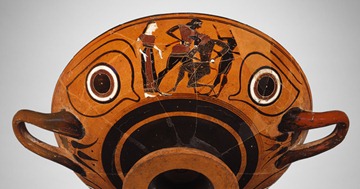 The middle of the 6th century B.C. saw a rapid proliferation of cup types: Komast cups, Siana cups, Gordion cups, Lip cups, Band cups, Droop cups, Merry-thought cups and Cassel cups – last only a few decades in terms of popularity. Some of these remain popular for only a few decades.
Explained Lynch, “Possessing what was newest in terms of mode and style of drinking cups was likely equated with knowledge and status. The elites may have been seeking cohesion and self definition in the face of factional rivalries and populist movements. This hypothesis underscores how the drinking symposia – and specific cup forms identified with specific factions – might have been used by aristocratic blocs to cement group bonds in the politically charged environment of the time.”
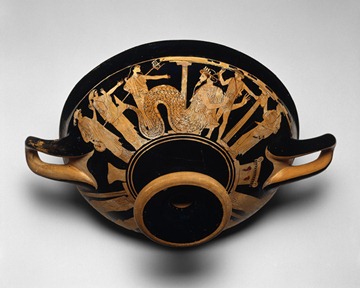 It’s estimated that drinking vessels for symposia comprised up to 60 percent of the terra cotta fineware (collection of dishes) in the typical Athenian home of this period. “The typical home had few useful dishes for eating in contrast to many vessels designed for drinking wine in communal settings,” explained Lynch.
This period ends with the devastating Persian Wars, which Greece won. The proliferation of cup types fell, with red-figured drinking cups, introduced around 525 B.C., becoming the most popular.
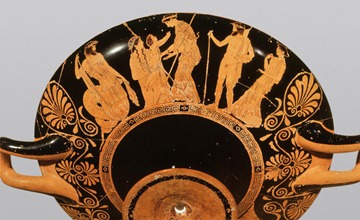 By the end of the 5th century B.C., Athens was weathering the Peloponnesian Wars and plague, and people were searching for an escape. This came in the form of an aesthetic restlessness. Fads in drinking cups came and went, but few developed into long-lived styles.
These new cup innovations tended to emulate the fineness commonly found in silver work at the time. For instance, there were many more plain, black clay cups with shiny surfaces. And delicate stamped and incised designs in clay cup interiors imitated metal prototypes on the cheap. In other words, the common terra cotta cups were “designer knock-offs” of the “high-end” designs found on silver cups.
Stemmed cups had finally run their course, being 200 years old at this point, and a stemless form became more popular.
Said Lynch, “People may have been seeking a visual antidote to the struggles of the period and a yearning for luxury at odds with daily conditions.”
 Also “running out of steam” in this period was the tradition of decorating cups with human figures. A decorative innovation, called West Slope, became popular at this time. It consisted of colored clay applied atop black-glazed surfaces to create the effects of garlands and wreaths. Human figures were no longer depicted.
Finally, as Athens fell under the sway of Philip of Macedon and his son, Alexander the Great, the symposium came full circle. It began in the Iron Age as a practice of the elite. Then, with the movement toward democratization in Athens, participation in symposia broadened. Now, in Athens’ Hellenistic period, the practice was again the prerogative of the elites as a luxury and display of ostentatious consumption. Equality was no longer important in a state that was no longer democratic but monarchical.
Lynch’s research on symposia of ancient Greece received funding from the Louise Taft Semple Fund of the Department of Classics at UC; the Samuel H. Kress Foundation; and the Sheldon H. Solow Foundation, Inc.
Author: M. B. Reilly | Source: Red Orbit [January 03, 2011] http://archaeologynewsnetwork.blogspot.com/
 How commonly used items – like wine drinking cups – change through time can tell us a lot about those times, according to University of Cincinnati research to be presented Jan. 7 by Kathleen Lynch, UC associate professor of classics, at the annual meeting of the Archaeological Institute of America.
Lynch will present the research at the event’s Gold Medal Session, when archaeology’s most distinguished honor will be bestowed on her mentor, Susan Rotroff of Washington University.
UC’s Lynch will present a timeline of wine drinking cups used in ancient Athens from 800 B.C. to 323 B.C. and will discuss how changes to the drinking cups marked political, social and economic shifts.
Background
Lynch’s specific area of study, which will result in a forthcoming book, is what’s known as the “symposium” in ancient Athens. These were gatherings held for nearly a millennia where communal drinking of wine was a means for cementing cultural norms and social bonds that carried over into the world of politics and business.Think of these symposia as the ancient world’s ultimate cocktail parties, with established rituals and rules. An important aspect of any symposium was the wine cup, and the form of and the imagery on the cups reflected the shared culture of participants, as well as the larger social realities and changes in their world during the following periods:
- Iron Age (1,100-700 B.C.)
- The Archaic Period (700-480 B.C.)
- The Late Archaic Period (525-480 B.C.)
- The High Classical Period (480-400 B.C.)
- The Late Classical Period (400-323 B.C.)
- The Hellenistic Period (323-31 B.C)
Basic rules of Athenian symposia
Couches or mattresses used by reclining participants were set in a circle or square. So, there was no formal position of status or group “head.” Drinkers imbibed in rounds, so consumption of wine (mixed with water) was equitable. In other words, everyone got drunk at about the same rate. No teetotalers permitted.
Said Lynch, “The focus was on drinking communally and in equal amounts. Inhibitions were lost. In-group bonds were formed.”
Why study these items? “Because,” stated Lynch, “People’s things tell you about those people and their times. In the same way that the coffee mug with ‘World’s Greatest Golfer’ in your kitchen cabinet speaks to your values and your culture, so too do the commonly used objects of the past tell us about that past. And, often, by studying the past, we learn about ourselves.”
Iron Age Symposia and Drinking cups (1,100-700 B.C.)
The drinking gatherings (symposia) were reserved for the elite, probably allowing political factions to consolidate power and set themselves apart from the population at large. In other words, the drinking gatherings were for the “in” crowd.![This three-foot-high Iron Age gravemarker is in the form of a mixing vessel (water and wine) used at symposia. It signals the importance of the symposia in Athenian society. People wanted to be remembered for their ability to sponsor these gatherings. [Credit: The Metropolitan Museum of Art]](http://lh3.ggpht.com/_BfC6j03vee0/TSL4uQZ3T2I/AAAAAAAAJU0/ksQVSyv889c/s1600-h/1atoasttohist5.jpg "This three-foot-high Iron Age gravemarker is in the form of a mixing vessel (water and wine) used at symposia. It signals the importance of the symposia in Athenian society. People wanted to be remembered for their ability to sponsor these gatherings. [Credit: The Metropolitan Museum of Art]") At this time, even grave markers for the very wealthy came in the form of the mixing bowls (kraters) used to blend wine with water during symposia. In other words, the ability to sponsor these drinking events was what people wanted to be remembered for.
At this time, even grave markers for the very wealthy came in the form of the mixing bowls (kraters) used to blend wine with water during symposia. In other words, the ability to sponsor these drinking events was what people wanted to be remembered for.The drinking cups during this period were simply decorated and rested directly on a base (no stem).
The Archaic Period (700-480 B.C.)
After the turn of the 6th century B.C., changes in the fashion of drinking cups began, corresponding with Athens’ rising political power and rising dominance in the ceramic market. Variety and quality were high during this period. It was the beginning of black-figured pottery production as well as plain, black-glazed versions. Stemmed cups became more popular, probably because they were easier to hold while reclining. The middle of the 6th century B.C. saw a rapid proliferation of cup types: Komast cups, Siana cups, Gordion cups, Lip cups, Band cups, Droop cups, Merry-thought cups and Cassel cups – last only a few decades in terms of popularity. Some of these remain popular for only a few decades.
Explained Lynch, “Possessing what was newest in terms of mode and style of drinking cups was likely equated with knowledge and status. The elites may have been seeking cohesion and self definition in the face of factional rivalries and populist movements. This hypothesis underscores how the drinking symposia – and specific cup forms identified with specific factions – might have been used by aristocratic blocs to cement group bonds in the politically charged environment of the time.”
Late Archaic Period (525-480 B.C.)
The overall number of wine-drinking vessels increased dramatically during this period, pointing to the democratization of the symposium, as well as the democratization of the political and social arenas. The masses had become the political, if not the social, equals of the elites, and these masses were now enjoying symposia of their own. It’s estimated that drinking vessels for symposia comprised up to 60 percent of the terra cotta fineware (collection of dishes) in the typical Athenian home of this period. “The typical home had few useful dishes for eating in contrast to many vessels designed for drinking wine in communal settings,” explained Lynch.
This period ends with the devastating Persian Wars, which Greece won. The proliferation of cup types fell, with red-figured drinking cups, introduced around 525 B.C., becoming the most popular.
High Classical Period (480-400 B.C.)
Red-figured cups (cups decorated with red figures vs. black) remain popular through the first part of this period of cultural development in Athens, but the cups grow taller and shallower. By the end of the 5th century B.C., Athens was weathering the Peloponnesian Wars and plague, and people were searching for an escape. This came in the form of an aesthetic restlessness. Fads in drinking cups came and went, but few developed into long-lived styles.
These new cup innovations tended to emulate the fineness commonly found in silver work at the time. For instance, there were many more plain, black clay cups with shiny surfaces. And delicate stamped and incised designs in clay cup interiors imitated metal prototypes on the cheap. In other words, the common terra cotta cups were “designer knock-offs” of the “high-end” designs found on silver cups.
Stemmed cups had finally run their course, being 200 years old at this point, and a stemless form became more popular.
Said Lynch, “People may have been seeking a visual antidote to the struggles of the period and a yearning for luxury at odds with daily conditions.”
Late Classical Period (400-323 B.C.)
Trends toward pseudo luxury (designer knock-offs) in drinking cups continued; however, the variety of these “silver-inspired” clay cup designs diminished after the turn of the 4th century B.C., probably because the forms were impractical. For instance, one clay cup – modeled on a silver drinking vessel – featured delicate high-swung handles that served no useful purpose in clay. Also “running out of steam” in this period was the tradition of decorating cups with human figures. A decorative innovation, called West Slope, became popular at this time. It consisted of colored clay applied atop black-glazed surfaces to create the effects of garlands and wreaths. Human figures were no longer depicted.
Finally, as Athens fell under the sway of Philip of Macedon and his son, Alexander the Great, the symposium came full circle. It began in the Iron Age as a practice of the elite. Then, with the movement toward democratization in Athens, participation in symposia broadened. Now, in Athens’ Hellenistic period, the practice was again the prerogative of the elites as a luxury and display of ostentatious consumption. Equality was no longer important in a state that was no longer democratic but monarchical.
Lynch’s research on symposia of ancient Greece received funding from the Louise Taft Semple Fund of the Department of Classics at UC; the Samuel H. Kress Foundation; and the Sheldon H. Solow Foundation, Inc.
Author: M. B. Reilly | Source: Red Orbit [January 03, 2011] http://archaeologynewsnetwork.blogspot.com/
Monday, 3 January 2011
Press Release!
News Release
Exploremykonos.com launches new website designed for independent travelers looking to experience quality and sustainable tourism in Mykonos.
London, UK, January 03, 2011 – Athens, Greece, Date Jan. 03, 2011 – Exploremykonos.com today launched an online travel website designed to provide quality services at preferential pricing for independent travelers looking to explore the finest Mykonos has to offer.
The London based company works directly with hotels, spas, private jets, restaurants and other local businesses to give its clients first class services at the most competitive prices.
Exploremykonos.com only partners with the best businesses to ensure their customer’s experience in Mykonos is second to none. In order to do this exploremykonos.com works with businesses that have been identified as having the highest caliber of services, are ecologically and environmentally conscious, customer focused, recognized for outstanding accommodation and they promote and support local community projects.
“When Independent travelers come to Mykonos they want to experience the absolute best of everything our culture has to offer,” said Lampros, General manager at exploremykonos.com “our Discount Code promotion, Best offers and Top Choices are here to help travelers plan a specialized holiday. Our philosophy is to explore, inform, share & gain”
Additionally, exploremykonos.com is a commission free service so that partners of the site can pass further savings onto their customers and benefit the local community.
About exploremykonos.com
exploremykonos.com is a privately owned company specializing in travel, accommodations and related services throughout Greece. For more information please visit exploremykonos.com, call +30 211 11 99 759 or email: info@exploremykonos.com and ask for a ‘become our partner’ brochure.
ATHENS OFFICE
Kleanthous 11,
Ilioupoli,
16344,
Attiki, Greece
tel.+30 211 11 99 759
fax. +30 2109768364
LONDON OFFICE
Wenlock Road
New North Road
London, United Kingdom
NL 7QR
Exploremykonos.com launches new website designed for independent travelers looking to experience quality and sustainable tourism in Mykonos.
London, UK, January 03, 2011 – Athens, Greece, Date Jan. 03, 2011 – Exploremykonos.com today launched an online travel website designed to provide quality services at preferential pricing for independent travelers looking to explore the finest Mykonos has to offer.
The London based company works directly with hotels, spas, private jets, restaurants and other local businesses to give its clients first class services at the most competitive prices.
Exploremykonos.com only partners with the best businesses to ensure their customer’s experience in Mykonos is second to none. In order to do this exploremykonos.com works with businesses that have been identified as having the highest caliber of services, are ecologically and environmentally conscious, customer focused, recognized for outstanding accommodation and they promote and support local community projects.
“When Independent travelers come to Mykonos they want to experience the absolute best of everything our culture has to offer,” said Lampros, General manager at exploremykonos.com “our Discount Code promotion, Best offers and Top Choices are here to help travelers plan a specialized holiday. Our philosophy is to explore, inform, share & gain”
Additionally, exploremykonos.com is a commission free service so that partners of the site can pass further savings onto their customers and benefit the local community.
About exploremykonos.com
exploremykonos.com is a privately owned company specializing in travel, accommodations and related services throughout Greece. For more information please visit exploremykonos.com, call +30 211 11 99 759 or email: info@exploremykonos.com and ask for a ‘become our partner’ brochure.
ATHENS OFFICE
Kleanthous 11,
Ilioupoli,
16344,
Attiki, Greece
tel.+30 211 11 99 759
fax. +30 2109768364
LONDON OFFICE
Wenlock Road
New North Road
London, United Kingdom
NL 7QR
Thursday, 30 December 2010
Wednesday, 29 December 2010
Tuesday, 28 December 2010
#SGT11
We are launching our new twitter campaign to Support Greek Tourism in 2011. If you are a Twitter fan then please use #SGT11 to express your support for Greek Tourism in 2011. You can share with us positive experiences, tips, advice or suggestions for destinations that you have visited and want to share with others. Our philosophy is to explore, inform, share and gain!
Greek tourism is the main drive of the Greek economy and many people and businesses are depending on tourism to survive. Exploremykonos, is promoting sustainable, quality forms of tourism in Greece.
Use #SGT11 to support one of the most beautiful destinations on the planet!
Greek tourism is the main drive of the Greek economy and many people and businesses are depending on tourism to survive. Exploremykonos, is promoting sustainable, quality forms of tourism in Greece.
Use #SGT11 to support one of the most beautiful destinations on the planet!
Monday, 15 November 2010
EXPLOREMYKONOS - WHAT IS IT ABOUT?
We created this website to inform, share and gain.
This website along with our social media network will serve as a platform for all of you to share information & knowledge about Mykonos and gain by saving time and money:
- exchange advise & tips for the best places or services
- connect with our partners and their services
- interact with other members
- organize your holidays
- get advantage of our best offers & discount code found on our website
- explore our Top choices and Exclusive Hotels or Villas
- find about events happening or organize your own
- and why not find a partner to go on holidays with!
We have negotiated better rates and offers on your behalf and we share them with you on our website through our ‘’discount code’’ promotion. Once you subscribe with our newsletter you will receive an email with your ‘’discount code’’ that you can use with our partners when you book with them.
Book with our partners directly. We guarantee you:
* A choice of quality accommodation
* To Save time and money
* Use of a discount code
* The best offers available
* Unparalleled service
* No commission and no hidden costs
We screen our partners on sustainable responsible tourism practices and make sure that local communities benefit as much as possible.
This website along with our social media network will serve as a platform for all of you to share information & knowledge about Mykonos and gain by saving time and money:
- exchange advise & tips for the best places or services
- connect with our partners and their services
- interact with other members
- organize your holidays
- get advantage of our best offers & discount code found on our website
- explore our Top choices and Exclusive Hotels or Villas
- find about events happening or organize your own
- and why not find a partner to go on holidays with!
We have negotiated better rates and offers on your behalf and we share them with you on our website through our ‘’discount code’’ promotion. Once you subscribe with our newsletter you will receive an email with your ‘’discount code’’ that you can use with our partners when you book with them.
Book with our partners directly. We guarantee you:
* A choice of quality accommodation
* To Save time and money
* Use of a discount code
* The best offers available
* Unparalleled service
* No commission and no hidden costs
We screen our partners on sustainable responsible tourism practices and make sure that local communities benefit as much as possible.
Your actions support quality sustainable & responsible tourism and local communities.
Our philosophy is simple! Inform, share and gain!
The people at eploremykonos.com wish you an amazing holiday!
Our philosophy is simple! Inform, share and gain!
The people at eploremykonos.com wish you an amazing holiday!
Sunday, 14 November 2010
BECOME OUR PARTNER!
A FEW WORDS ABOUT US
We are a new online travel service, with offices in London, England and Athens, Greece. We promote quality and sustainable forms of tourism to Greece.
Our focus is to bring independent travellers in touch with the unique Mykonian culture and its authentic people, in destinations that are both on and off the beaten track, helping them relax and spend quality time with friends and family.
Our travellers are able to share knowledge and gain experiences by visiting exciting destinations offered by our network of carefully chosen partners.
Our mission is to help explore inform, share, gain and above all show that there is more to travel !
We are a travel focused service that brings together people, in a knowledge sharing journey.
PARTNERS
WHAT ARE WE LOOKING FOR IN OUR PARTNERS?
We are looking for partners that share our passion and are willing to join our efforts.
Guidelines and procedures for quality responsible Tourism
• A procedure for responding to travellers complaints & feedback on sustainable travel practices
ENVIROMENTAL
• Efforts to reduce waste and save energy (reduce-reuse-recycle).
• Evidence that travellers are provided with suggestions how to reduce water use in their destinations.
• Evidence that travellers are provided with relevant suggestions to minimise damage to the environment, wildlife and marine ecosystems.
COMMUNITY
• Evidence that the partner promotes visits to appropriate local projects with direct or indirect environmental benefits.
• Evidence that travellers are provided with suggestions of ways to minimise negative impacts on local cultures
• Evidence that the partner provides suggestions for destination visits to appropriate local social projects with direct or indirect benefits to the host community.
• Evidence that the partner employs local people wherever possible under fair employment practices.
• Evidence of ethical management and leadership.
• Evidence that the partner makes use of local produce, manufacturers and other services.
• Evidence that travellers are provided with suggestions of local services that provide local community benefits (e.g. restaurants, guides, shops, craft markets)
WHY SHOULD YOU LIST YOUR SERVICES WITH US?
1. WE LOVE GREECE.
2. We offer a no commission service so that the locals earn more income as land managers, entrepreneurs, service and produce providers, and employees.
3. Tourism enables the traveller to discover local habitats and wildlife, and celebrates and respects traditional cultures, rituals and wisdom.
4. Creates a bond between our customers and the local community and ensures repeat business and benefits for all.
5. Greece is promoting quality sustainable forms of tourism as an alternative to mass tourism. You don't necessarily make more money through mass tourism when you look at the cost of mass tourism, the cost to your local environment and the cost to your culture.
6. We aim to create services that will help change and extend the seasonal face of Greece (July-August) into an exciting all year round destination.
7. We aim to change the perception of Greece as a Sea and Sun destination by promoting our cultural heritage and diverse natural beauties
8. We aim to show our customers that they can find unique experiences in Mykonos
9. To achieve the above we want you to honour us with your finest service.
10. Please spread the word to your community, friends and family.
HOW CAN WE WORK TOGETHER?
1. Register your interest to get your services listed with exploremykonos.com via email: info@exploremykonos.com
2. We will then contact you to discuss further details.
We will discuss the service you offer.
• How does it compare with our service and efforts?
• What benefits does it bring to our customers?
• If you are willing to participate in our best offers deals, top choices and discount code promotion.
• How can we enhance the travel experience of our customers through your service?
• Introduce us to your community. How can we utilise your contacts within the local community to everyone’s benefit?
• Inform us about regular or extraordinary events and other local activities you or others organise in your area to include in our online blog.
• What are the local issues and how can we help in community projects?
• Include us in the recipient list of your newsletters or of the periodical publications, which you or your associates undertake.
• Include us as a link on your portal, website, or blog.
• Add us on your online social network.
3. Once all details are discussed we will agree on terms and conditions of service and payments.
We are a new online travel service, with offices in London, England and Athens, Greece. We promote quality and sustainable forms of tourism to Greece.
Our focus is to bring independent travellers in touch with the unique Mykonian culture and its authentic people, in destinations that are both on and off the beaten track, helping them relax and spend quality time with friends and family.
Our travellers are able to share knowledge and gain experiences by visiting exciting destinations offered by our network of carefully chosen partners.
Our mission is to help explore inform, share, gain and above all show that there is more to travel !
We are a travel focused service that brings together people, in a knowledge sharing journey.
PARTNERS
WHAT ARE WE LOOKING FOR IN OUR PARTNERS?
We are looking for partners that share our passion and are willing to join our efforts.
Guidelines and procedures for quality responsible Tourism
• A procedure for responding to travellers complaints & feedback on sustainable travel practices
ENVIROMENTAL
• Efforts to reduce waste and save energy (reduce-reuse-recycle).
• Evidence that travellers are provided with suggestions how to reduce water use in their destinations.
• Evidence that travellers are provided with relevant suggestions to minimise damage to the environment, wildlife and marine ecosystems.
COMMUNITY
• Evidence that the partner promotes visits to appropriate local projects with direct or indirect environmental benefits.
• Evidence that travellers are provided with suggestions of ways to minimise negative impacts on local cultures
• Evidence that the partner provides suggestions for destination visits to appropriate local social projects with direct or indirect benefits to the host community.
• Evidence that the partner employs local people wherever possible under fair employment practices.
• Evidence of ethical management and leadership.
• Evidence that the partner makes use of local produce, manufacturers and other services.
• Evidence that travellers are provided with suggestions of local services that provide local community benefits (e.g. restaurants, guides, shops, craft markets)
WHY SHOULD YOU LIST YOUR SERVICES WITH US?
1. WE LOVE GREECE.
2. We offer a no commission service so that the locals earn more income as land managers, entrepreneurs, service and produce providers, and employees.
3. Tourism enables the traveller to discover local habitats and wildlife, and celebrates and respects traditional cultures, rituals and wisdom.
4. Creates a bond between our customers and the local community and ensures repeat business and benefits for all.
5. Greece is promoting quality sustainable forms of tourism as an alternative to mass tourism. You don't necessarily make more money through mass tourism when you look at the cost of mass tourism, the cost to your local environment and the cost to your culture.
6. We aim to create services that will help change and extend the seasonal face of Greece (July-August) into an exciting all year round destination.
7. We aim to change the perception of Greece as a Sea and Sun destination by promoting our cultural heritage and diverse natural beauties
8. We aim to show our customers that they can find unique experiences in Mykonos
9. To achieve the above we want you to honour us with your finest service.
10. Please spread the word to your community, friends and family.
HOW CAN WE WORK TOGETHER?
1. Register your interest to get your services listed with exploremykonos.com via email: info@exploremykonos.com
2. We will then contact you to discuss further details.
We will discuss the service you offer.
• How does it compare with our service and efforts?
• What benefits does it bring to our customers?
• If you are willing to participate in our best offers deals, top choices and discount code promotion.
• How can we enhance the travel experience of our customers through your service?
• Introduce us to your community. How can we utilise your contacts within the local community to everyone’s benefit?
• Inform us about regular or extraordinary events and other local activities you or others organise in your area to include in our online blog.
• What are the local issues and how can we help in community projects?
• Include us in the recipient list of your newsletters or of the periodical publications, which you or your associates undertake.
• Include us as a link on your portal, website, or blog.
• Add us on your online social network.
3. Once all details are discussed we will agree on terms and conditions of service and payments.
Subscribe to:
Posts (Atom)